
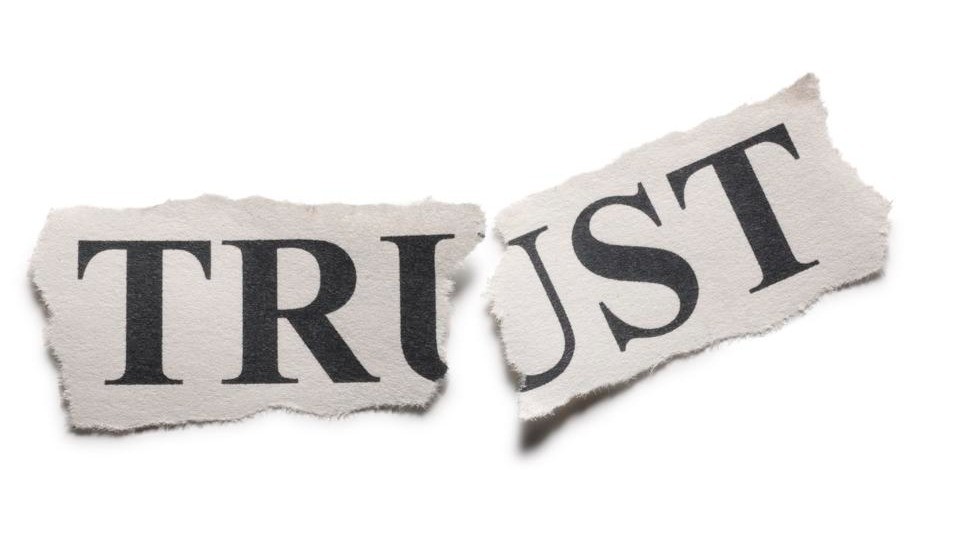
The Trust Crisis: We’ve Lost Our Shared Reality
Episode 9 of the Building Bridges Series
4-minute read
In 1972, about 70% of Americans said they trusted their government to do what is right most of the time. Today, that number hovers around 20%. In 1970, Democrats and Republicans were nearly equally likely to trust the media—74% and 68% respectively. Now it’s 54% of Democrats but only 12% of Republicans.
We’re not just talking about declining numbers on a survey. We’re witnessing the collapse of something fundamental: our ability to agree on basic facts about reality.
As President Obama noted, we now have “a situation where we’re not just arguing policy or values or opinions, but basic facts are being contested and that is a problem.”
The Institutional Collapse
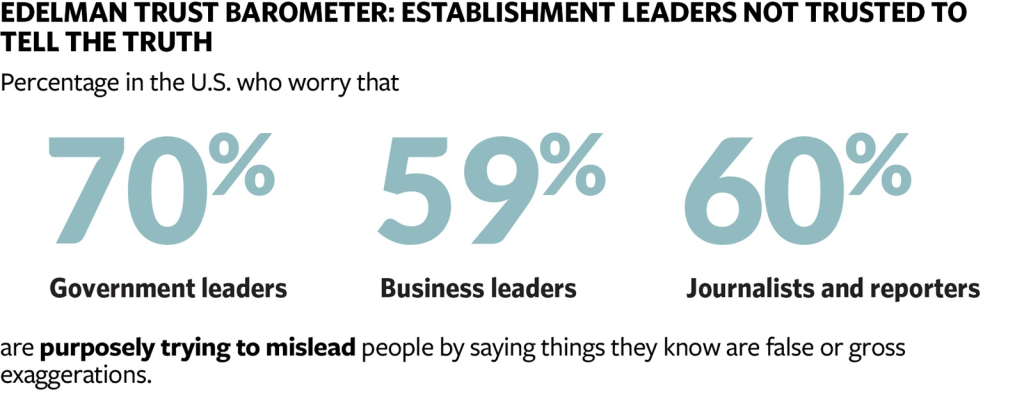
The erosion of trust spans virtually every major institution in American life. Government agencies, news organizations, educational institutions, law enforcement, religious organizations, the Supreme Court, big business, unions, banks, even the electoral system itself—all have seen their credibility plummet over recent decades.
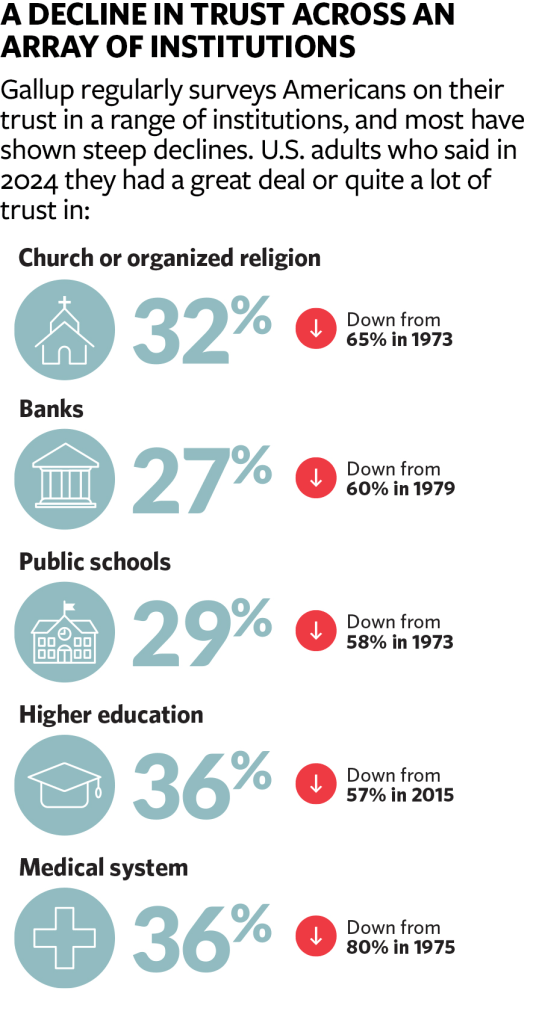
The numbers are staggering. In 2024, Pew Research found that the trust gap between Democrats and Republicans on various government agencies reached extraordinary levels: 92 points for the CDC, 80 points for the EPA, 62 points for the FBI. These aren’t just policy disagreements—they represent fundamentally different assessments of institutional credibility, and whether they should even exist.
To make matters worse, there are powerful political forces that are relentlessly attacking trust in our American institutions, as well as scientific knowledge and expertise in general. We can argue about what their motives are, but the end result is that it continues to weaken our shared beliefs in facts and the truth. Throw in social media (where everyone is a publisher) and the emergence of AI-generated content and it’s no wonder that a shared reality is becoming less and less likely.
Trust and Tribal Identity
This connects directly to my earlier discussions about tribal identity and worldview filters. We now live in different information ecosystems, with different trusted sources and different accepted facts. Our tribal affiliations increasingly determine not just what we believe, but who we trust to tell us what’s true.
When institutions are perceived as belonging to “the other tribe,” their credibility evaporates. This creates a vicious cycle: as institutional trust fractures along tribal lines, institutions themselves become viewed as partisan actors, further eroding their legitimacy.
Remember how our confirmation bias makes us more likely to accept information that confirms our existing beliefs? When combined with tribal loyalty, this creates what researchers call “motivated reasoning”—we trust sources that tell us what our tribe believes and distrust those that challenge it.
Beyond Institutions: The Personal Trust Crisis
The crisis extends beyond institutions to interpersonal trust. Only about 30% of Americans now believe that “most people can be trusted”—down from over 40% in the 1970s.
This decline isn’t evenly distributed. Americans with lower levels of education and income are less likely to express trust in others. Significant racial and ethnic differences persist, as well.
People learn to trust others based on how they themselves have been treated, so if you have faced discrimination, economic hardship, or other personal “scarring events” in your life, you’ll naturally develop more guarded attitudes toward trust.
The Drivers of Institutional Trust
Research shows that trust in institutions depends on perceptions of their reliability, responsiveness, openness, fairness, and integrity. When institutions are seen as effective, transparent, and accountable, trust tends to be higher.
The problem is that effectiveness and accountability are increasingly viewed through tribal lenses. The same agency might be seen as highly effective by one group and completely corrupt by another, depending on whether its actions align with that group’s worldview and priorities.
Local institutions tend to maintain higher trust ratings than national ones (including our elected representatives), perhaps because they feel more like “our tribe”—we can see their impact directly and hold them accountable more easily.
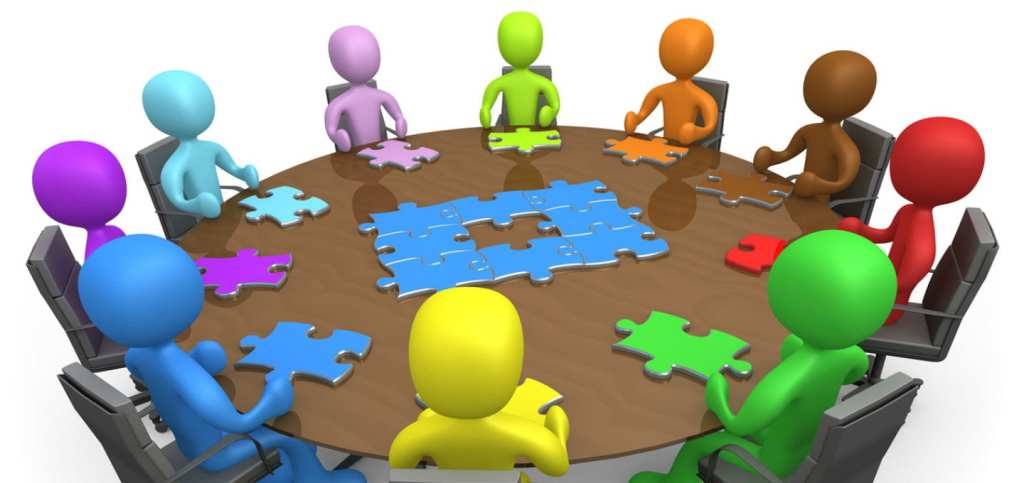
The Path Forward: Rebuilding Shared Reality
How do we rebuild trust in a fractured society? The data suggests several approaches:
Start local: Focus on rebuilding trust in community-level institutions where people can see direct impact and maintain personal relationships with leaders.
Emphasize shared values: Instead of focusing on divisive policies, highlight common concerns like safety, opportunity for children, and community wellbeing.
Increase transparency and accountability: Institutions must work harder to demonstrate their effectiveness and integrity, especially to groups that have lost faith in them.
Address underlying inequalities: Trust gaps often reflect real differences in how institutions have treated different communities. Rebuilding trust may require acknowledging and addressing these disparities. And remember that this applies to BOTH sides of the divide.
Practice patience: As my earlier posts about Moral Foundations and Worldviews pointed out, people’s fundamental beliefs change slowly. Rebuilding trust will be a generational project, not a quick fix.
Individual Responsibility
While institutional reform is necessary, we also bear individual responsibility for the trust crisis. Each time we share unverified information, dismiss sources because of their tribal affiliation, or assume the worst about those who disagree with us, we contribute to the erosion of shared reality.
The Beautiful Questions I discussed in my last post become crucial here: Instead of asking “How can they believe that?”, try “What experiences might have led them to that conclusion?” Consider whether this other person may know something that you hadn’t ever thought of before. Try To Be Curious, Instead Of Furious.
A majority of Americans (58%) agree that it’s important to raise our level of confidence in each other. Around 90% believe we can make progress. The most-mentioned solutions? Being less partisan, embracing values like honesty and kindness, and electing more inspiring leaders. And if you happen to be running for office, remember: When someone doesn’t vote for you, it may not be because they disagree with you–it may be because they don’t trust you.
The trust crisis didn’t develop overnight, and it won’t be solved quickly. But understanding how we got here—and why trust matters so much for a functioning democracy—is the first step toward finding our way back to shared ground.
How have you noticed that your own trust in certain institutions has changed over time? Have you caught yourself dismissing an opinion or some new information, because you have assumed that the source can’t be trusted? And would you agree that “most people can be trusted”? If not, why not?

If you’re interested in a more Global Perspective on Trust, check this out:
https://www.ipsos.com/en/interpersonal-trust-across-the-world
Sources:
- https://www.pewresearch.org/2025/05/08/americans-trust-in-one-another/
- https://www.pew.org/en/trend/archive/fall-2024/americans-deepening-mistrust-of-institutions
- https://www.pew.org/en/trend/archive/fall-2024/data-behind-americans-waning-trust-in-institutions
- https://news.gallup.com/poll/508169/historically-low-faith-institutions-continues.aspx
Addendum:
Recent Polling of Republicans & Democrats show that both sides see each other as “dishonest” and “closed-minded”
In your experience, when you talk about politics with Republicans, do you generally find [them] to be _____?
| Mostly open-minded | Mostly closed-minded | Mostly honest | Mostly dishonest | |
|---|---|---|---|---|
| Republicans say… | 76% | 23% | 91% | 8% |
| Democrats say… | 13% | 85% | 32% | 65% |
| Independents say… | 31% | 69% | 45% | 54% |
In your experience, when you talk about politics with Democrats, do you generally find [them] to be _____?
| Mostly open-minded | Mostly closed-minded | Mostly honest | Mostly dishonest | |
|---|---|---|---|---|
| Democrats say… | 85% | 13% | 88% | 11% |
| Republicans say… | 17% | 82% | 27% | 72% |
| Independents say… | 53% | 46% | 63% | 36% |
Source: NPR/PBS News/Marist Poll of 1,443 U.S. adults, conducted Nov. 10-13, 2025. The margin of error for Democrats is 5.3 percentage points and for Republicans, 5.6 percentage points. Percentages may not add up to 100 due to rounding. “Unsure” responses are not shown.Credit: Sanidhya Sharma and Alyson Hurt/NPR
Up Next:
“Your Creation Story: How Origin Myths Shape Our Worldviews”





 Building Bridges To Common Ground
Leave a comment