
American Nations: The United States Has Never Been United
Episode 17 of the Building Bridges Series
A 4-minute read
We’ve all heard the story of America as a “melting pot.” The narrative of a unified nation forged through revolution and bound by shared values.
But what if the story we learned in school wasn’t completely true?
The Origin Story We Weren’t Taught
Historian Colin Woodard’s book American Nations changed the way I understood American History. It blew up the simple, heroic origin story I learned as a kid—the one that left out an awful lot of important (and useful) information.
Our authentic origin story isn’t one narrative about brave colonists joining together to create one nation. It’s actually a collection of overlapping stories that played out simultaneously, each with different groups pursuing different visions of what society should be.
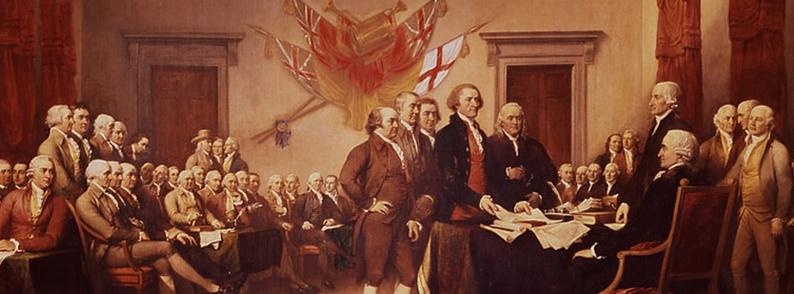
Americans have been deeply divided since the days of Jamestown and Plymouth. The original colonies were settled by people from distinct regions of the British Isles, France, the Netherlands, and Spain. Each group brought their own religious beliefs, political ideas, and cultural characteristics. During the colonial period, they regarded one another as competitors—and sometimes as enemies.
The Eleven Nations
According to Woodard, America’s most essential and longest-lasting divisions aren’t between red states and blue states, conservatives and liberals, or any of the usual categories we use. Rather, our divisions stem from this fact: the United States is a federation made up of eleven different regional cultures, some of which truly don’t see eye to eye with one another.
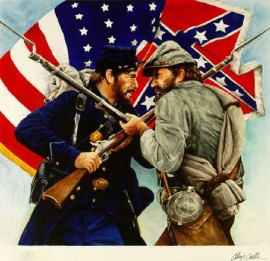
Only when London began treating its colonies as a single unit—and enacted policies threatening to nearly all—did these distinct societies briefly join together to win a revolution and create a shared government. Nearly all of them would seriously consider leaving the Union in the 80 years after independence (some are still discussing it today). And of course, several of these “nations” actually went to war to escape the Union in the 1860s.
These cultural regions respect neither state nor country boundaries. They bleed over into Canada and Mexico just as easily as they divide California, Texas, Illinois, or Pennsylvania.

Consider “Yankeedom,” founded on Massachusetts Bay’s shores by radical Calvinists seeking to build a religious utopia. This culture emphasized education, local political control, citizen involvement, and pursuing the “greater good” of the community, with an underlying faith in government’s potential to improve people’s lives.
In sharp contrast, “Tidewater” was founded by younger sons of wealthy southern English families who aimed to recreate the semi-feudal manor society of the English countryside. This region has always been fundamentally conservative, placing high value on respect for authority and tradition, but very little on equality or public participation in politics. Tidewater culture believed in the benefit of a God-ordained aristocracy—that those born to privilege and position should make decisions for everyone else. When the Declaration proclaimed “all men are created equal,” Tidewater elites interpreted “men” very narrowly, excluding enslaved people, women, and those without property from that equality.
Each of our founding cultures had its own set of cherished principles, and they often contradicted one another—and sometimes contradicted themselves. Some championed individualism, others utopian social reform. Some believed themselves guided by divine purpose, others championed freedom of conscience. And some proclaimed equality while maintaining aristocratic hierarchies. All of them continue to champion some version of their founding ideals today.
For more:
Here’s a link to concise descriptions of the Eleven Rival Nations that Woodard writes about.
The Lines on the Map Are Illusions
Remember our discussion about the myth of solid red and blue states? Woodard’s work helps explain why those labels feel so inadequate.
The conventional map’s boundaries are largely arbitrary, slashing through cohesive cultures and creating massive cultural fissures within states like Maryland, Oregon, or New York. Residents in some states often have more in common with neighbors in another state than they do with one another.
State and country borders are necessary political realities, but they mask the real forces that have always driven affairs on our continent: the eleven stateless nations of North America.
A Nation Is Not a State
Here’s an important distinction: as Woodard explains, a “nation” is a group of people who share—or believe they share—a common culture, language, history, and values. It’s about identity and belonging, not political boundaries.
And here’s another critical point: becoming a member of a nation usually has nothing to do with genetics and everything to do with culture. You don’t inherit a national identity the way you inherit eye color. You acquire it by growing up in that culture or, with effort, through voluntary assimilation later in life. If you talk, act, and think like a Midlander, you’re probably a Midlander, regardless of where your parents or grandparents came from.
Democracy Is Hard—And Always Has Been
Few of these nations have shown any indication that they are melting into some sort of unified American culture. On the contrary, since 1960 the fault lines between them have grown wider, fueling culture wars, constitutional struggles, and ever more frequent pleas for unity. Over the past decade, this challenge has become even more pronounced.
As filmmaker Ken Burns reminds us in his recent documentary series, The American Revolution, “Knowing our origin story gives us a chance to come together and realize how much we share in common”, understanding that “the quest to maintain that society, and to strive to achieve a more perfect union, is far from over.”
The United States has always been an experiment—perhaps the most ambitious democratic experiment in human history. We’re attempting something unprecedented: maintaining a functioning democracy across multiple distinct cultural nations, each with its own deeply held values and worldviews.
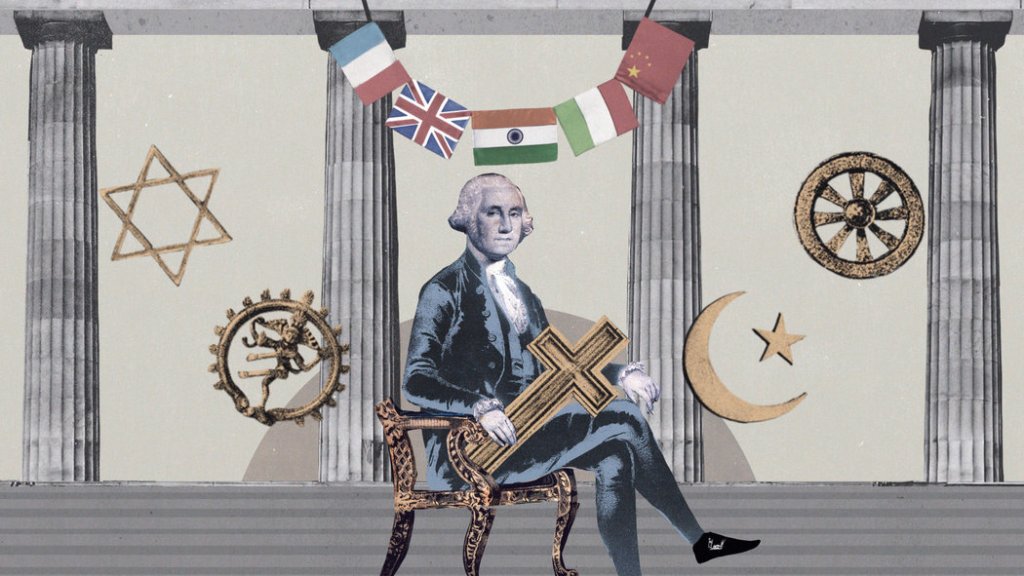
Diversity of worldviews is built into our country’s DNA. It’s part of what it means to be “an American.”
The challenge of bridging our cultural divides has always been with us. It becomes especially urgent in times of heightened polarization like now. The question isn’t whether we can merge into one unified worldview—that’s probably impossible—but how we can live together better as a community of distinct nations under one federal umbrella.
What does this more complex American origin story bring up for you? Feel free to add your thoughts.
Primary source for this article:
American Nations: A History of The Eleven Rival Regional Cultures Of North America, by Colin Woodard (2011). Recommended reading for any American!
Up Next:
“From Villages To Tribes: What Happened To Our Shared Community?“






 Building Bridges To Common Ground
Leave a comment