
Politically Homeless: Why So Many of Us Don’t Fit the Left/Right Labels
Episode 15 of the Building Bridges Series
A 4-minute read
If you feel like neither major political party represents your values anymore, you’re not alone. You’re part of a growing majority of Americans who find themselves politically homeless.
The Binary Trap
American politics presents us with a stark choice: Republican or Democrat. Red or Blue. Conservative or Liberal. Pick a side.
But what if your actual beliefs don’t fit neatly into either box?
Maybe you believe in fiscal responsibility AND environmental protection. Perhaps you support gun rights and also universal healthcare. You might be pro-life and anti-death penalty. Or you could support both strong borders and compassionate immigration reform.
None of these combinations are contradictory—they just don’t align with the pre-packaged positions offered by our two major parties.
Remember our earlier discussion about moral foundations? We talked about how people weight the six moral foundations (Care, Fairness, Loyalty, Respect For Authority, Sacredness, and Liberty) differently. Your unique moral profile might put extra emphasis on care and loyalty, or fairness and liberty. But our political parties demand you choose between a set of foundations that usually aren’t a perfect match for your personal values.
When Political Parties Don’t Match Your Moral Profile
Here’s something crucial to understand: political parties are not moral orientations. They are strategic coalitions, built to win elections.
Being “conservative” or “liberal” in your thinking—how you weigh different moral foundations, how you feel about change and tradition—is different from being a Republican or Democrat. The first describes your cognitive and moral patterns. The second describes which team you’ve joined (or not).
This distinction matters because it explains why so many people feel politically homeless. Your moral foundations haven’t changed, but the parties have continually moved around you. Or you’ve realized the party never quite matched your values—you’ve just been choosing the closer of two imperfect options.
According to Gallup, the percentage of Americans identifying as Independent has hovered around 40-45% for years, often exceeding those identifying with either major party. That’s not apathy—that’s a massive group of people saying “neither of these options represents me.”
The Media’s Red vs. Blue Obsession
Turn on any news channel during election season and you’ll see the same framing: Red states vs. Blue states. Republican voters vs. Democratic voters. The horse race between two teams.
But notice what’s missing? The 40-45% of voters who don’t identify strongly with either party get mentioned almost as an afterthought, if at all. “Independents” become a footnote in any analysis that is focused on a binary choice.
This media framing reinforces the false binary and makes it harder to imagine politics beyond the two-party system. It treats complexity as confusion and nuance as indecision, or even weakness.
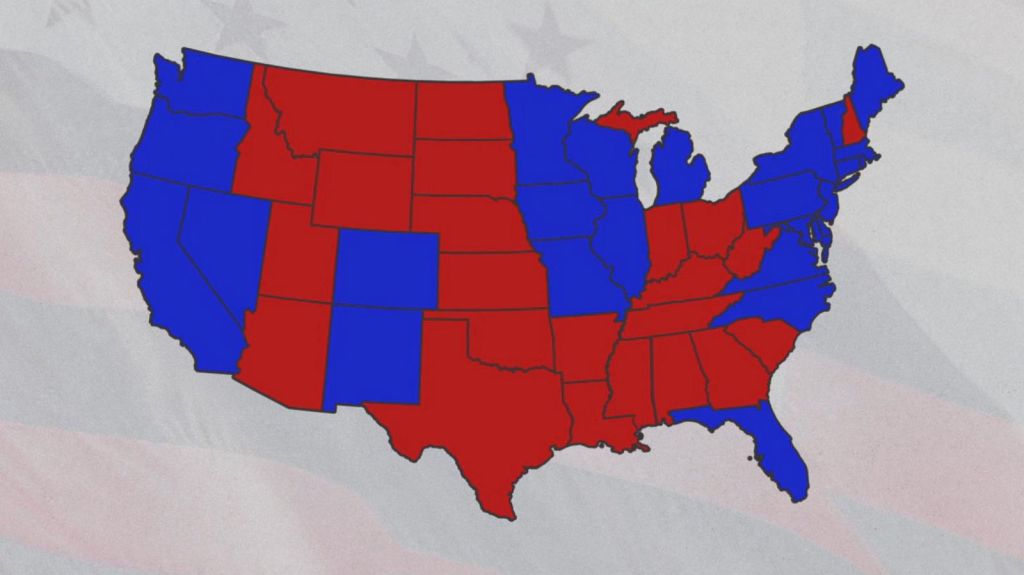
The Myth of Solid Red and Blue States
The red state/blue state narrative creates another distortion: it suggests that populations are uniformly one color or another.
Consider my home state of Vermont, which has a reputation as an extremely liberal “blue” state. Yet almost 1 out of 3 Vermonters voted for Donald Trump in the 2024 presidential election. All those Trump voters become invisible every time the “blue” label gets slapped on.
Similarly, in “red” Texas, Biden received 46.5% of the vote in 2020. Even in famously “blue” California, Trump got 34%. Very few of our states experienced a true landslide. That’s evidence of substantial political diversity, even within states that get painted with a single color.
When we accept the red/blue framing, we erase millions of people whose views don’t match their state’s dominant color. And we disregard the political complexity that exists in every community. The fact is, the collective thinking of people in most states would be best described as varying shades of Purple.
Finding Your Political Home in a Homeless Era
So what do you do if you’re politically homeless?
First, recognize you’re not broken or confused. The two-party system is simply inadequate for capturing the full range of reasonable political positions. Your moral complexity is normal—it’s the binary framework that’s limiting.
Second, consider focusing on specific issues and values rather than party loyalty. Organizations like No Labels and The Forward Party are working to identify “Common Sense” policies that could appeal across traditional party lines—ideas focused on solving problems rather than winning team battles.
Third, look beyond the presidential race to local politics, where pragmatic problem-solving often matters more than ideological purity. Governors, mayors, and local officials frequently succeed by focusing on what works rather than what their national party demands.
Finally, remember that being politically homeless doesn’t mean being politically powerless. It means you have the freedom to evaluate ideas on their merits rather than their party affiliation. You can support candidates and policies based on your actual values, not tribal loyalty.
The question isn’t whether you fit into the red box or the blue box. The question is what you actually stand for—and how you can work with others who share some of your values, even if they don’t share all of them.
Do you feel politically homeless? What values do you prioritize that don’t fit neatly into either party’s platform? Feel free to add your thoughts.
Up Next:
“When Labels Divide Us: The Damage Done By Identity Politics“





 Building Bridges To Common Ground
Leave a comment